Skip to content

Language : FR EN

Custom business software and information systems for SMEs

Business software that follows how your company really works, connected to your other tools, and owned by you. For SME owners, finance leads and operations managers tired of stacking spreadsheets and subscriptions. Designed by someone who has run an information system.

Describe your project Book a 30-min call
  • Reply within 24 h
  • Written quote
  • You own the code and data

At a glance

Who it is for
SME owners, finance leads and operations managers
What you get
A tool built around your processes and connected to your software
Ownership
Code, data and accounts in your name
Where
Based in Nice on the French Riviera, working remotely across Europe

What is custom business software?

Custom business software is a tool built around your company's own processes: quotes, orders, stock, scheduling, invoicing, customer follow-up. It replaces spreadsheets and double entry with a single source of data, connects to your other software and belongs to you, with no per-user subscription.

An "information system" is the whole set of these tools and the data they exchange: what your team uses to sell, produce, invoice and steer the business. I design it as one whole, not as a pile of isolated apps. Every piece shares the same customers, products and figures, which is what removes re-keying.

When does custom software make sense, and when is off-the-shelf enough?

Off-the-shelf software is often enough, and I will tell you so. Custom software is worth it when several of these signals add up.

  • You re-enter the same information in a spreadsheet, then in one tool, then in another.
  • Your tools do not talk to each other: orders, stock and invoicing each live on their own.
  • You work around your tool with spreadsheets because it does not match how you work.
  • You bend your process to fit the tool, instead of the other way round.
  • Licence costs grow with every new user.
  • An ageing system that nobody fully understands any more is blocking change.

Your process

Off-the-shelf software
Standard and already covered: off-the-shelf is enough.
Custom software
Specific or a competitive edge: an off-the-shelf tool forces you to bend it.

Getting started

Off-the-shelf software
Fast, with configuration left to you.
Custom software
Scoping first, then a first core delivered in stages.

Links to your tools

Off-the-shelf software
Limited to what the vendor offers.
Custom software
Connected to what you use: accounting, payment, website.

Cost over time

Off-the-shelf software
A subscription, often per user, that grows with you.
Custom software
An upfront investment, then maintenance, with no per-user licence.

Code and data

Off-the-shelf software
Held by the vendor, under its export terms.
Custom software
Held by you: code, data and accounts.

If off-the-shelf software already covers your need, use it. I would rather tell you at the first conversation than build something that already exists.

What I build

Four families of tools, combined around the same data.

ERP and business management tools

Quotes, orders, stock, scheduling, invoicing: the core of your activity in a single tool, with access rights suited to each role. At NHN Menuiserie, a configurator calculates the price per square metre and produces the PDF quote.

CRM and customer portals

Tracking of prospects, cases and follow-ups, and spaces where your customers find their own information. At Vellassur, a mini-CRM was delivered in under a week.

See the custom CRM

Integrations and APIs

Connections to your accounting, your payments, an existing ERP or your partners' tools, to remove re-keying. E-invoicing makes this work timely for many French SMEs.

See the Pennylane integration

Dashboards and automations

The figures you need, up to date without manual exports, and repetitive tasks (reminders, document sending, reconciliations) handled by the tool.

An information system designed by a former CTO

For four years I was the full-time CTO of Star Croisières, an online cruise agency in Monaco. The IT department was under my responsibility: architecture choices, hiring the team, production incidents, trade-offs with management. I know what keeps a business tool alive after delivery, and what makes it unmanageable two years later.

What this changes for you

  • An architecture built to last and evolve, not to look good in a demo.
  • Protected data: role-based access and regular backups.
  • Documentation handed to your team or to your next provider.
  • Testable deliveries: you validate each stage before the next one.
  • Real reversibility: another developer can take over the code.

The method: map, deliver a first core, extend

Three stages, so the tool is useful fast and does not drift in every direction.

  1. Map your processes

    Together we describe who does what, with which tools, and where double entry and spreadsheets hide. You receive a written quote: scope, delivery order and terms.

  2. Deliver a first useful core

    I put into service first the module that saves you the most time, along with your existing data. Your team uses it quickly, and its feedback steers what comes next.

  3. Extend module by module

    New modules, integrations, dashboards and automations are added without starting over, with tests on the critical paths and up-to-date documentation.

Replace an existing tool without stopping the business

Few companies start from a blank sheet: there is already a tool, spreadsheets, years of data. The order of the steps matters. Data and uses are moved over in ordered stages, I check that the new tool gives the same results as the old one, then we switch. This is the method I use to replace an information system without a service interruption.

See the IT system migration service

An existing tool that is fragile and that nobody masters any more? An audit gives the state of the code and a prioritised action plan before you decide to fix it or replace it.

See the Laravel and PHP audit

Management systems delivered or in progress

In order: an information system run for four years, an internal management tool, then an ongoing assignment.

Full-time CTO

Star Croisières

CTO, Monaco, 2021 to 2025

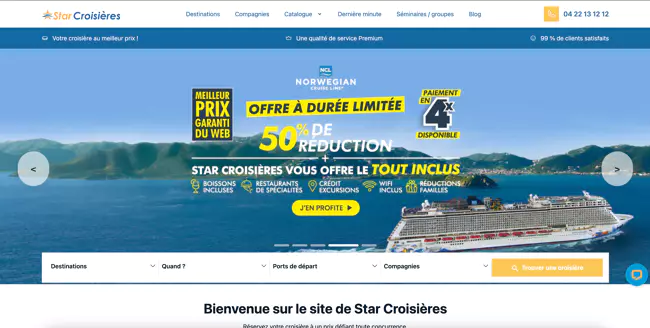
I ran the IT department of this online cruise agency: replacement of an information system about ten years old, proprietary CRM and CMS, and a team of six developers hired and managed.

revenue
×3
system availability
99.998%
developers hired
6
Screenshot of the Star Croisières website, an online cruise agency

NHN Menuiserie

CTO and architect

Three brands, one tool: catalogue, per-square-metre price configurator, PDF quotes, invoicing at several VAT rates and an internal CRM tracking quotes and customers.

Celeste

Lead Developer, supporting the tech lead

Replacing one information system with another at an operator that has acquired several operators, without cutting service to customers. Ongoing assignment: no result published.

Ongoing assignment

Celeste is an ongoing assignment, so I publish no result from it. Its method is described in the IT system migration service.

What clients and colleagues say

Yassir has been with the company since 2019. Starting as an apprentice, then intern, he became the driving force of our IT team. He progressed quickly and established himself as an indispensable person. Becoming CTO at a crucial moment, he recruited a new team and led the department successfully despite his young age. His passion, motivation and autonomy are beyond question. I highly recommend him.

Victor Flores Sales director, Star Croisières, 2024

Yassir brought a true CTO mindset to this project, combining technical vision with a deep understanding of business challenges. His structured and proactive approach allowed us to effectively scope the different phases, particularly the CRM implementation, which was a major strategic undertaking. Beyond delivery, Yassir challenged requirements, proposed tailored solutions and drove progress with rigour and responsiveness throughout the project. Communication was always seamless, and technical decisions were made in alignment with our business objectives. The work delivered is of outstanding quality and fully meets our expectations. We are continuing the collaboration on the next phase of the project with complete confidence. I strongly recommend him for any engagement requiring genuine technical and strategic guidance.

Ngoc Nguyen Owner, NHN Menuiserie, 2026

I reached out to Yassir and was particularly impressed by how fast he works. From the very start, his questions were sharp and precise, which allowed him to deliver work that was clear, transparent, and highly efficient. Beyond his technical skills, Yassir truly understood my needs. He even anticipated certain choices by proposing a visual identity consistent with my logo, resulting in a perfectly cohesive final product. The level of precision and professionalism is remarkable - it's hard to find the words, the quality speaks for itself. I feel genuinely lucky to have worked with him. I recommend Yassir without hesitation.

Cédric Vella Owner, Vellassur, 2026

What makes the budget vary

I do not publish a price list: two business tools can cost very differently. Five factors explain most of the gap.

The number of modules
A single module (order tracking, for example) or several sharing the same data: scope is the first factor.
Integrations
Each connection to external software (accounting, payment, an existing ERP) means studying how it works, handling errors and testing the exchanges.
Existing data
Clean spreadsheets are quick to import. Years of inconsistent data need cleaning, done with you.
The number and types of users
The more roles with different rights, the more rules there are to design and test.
Maintenance and hosting
Updates, backups, monitoring and changes: planned from the start, they are part of the cost over time.

A useful first core, then extensions

Rather than one large fixed project, I suggest starting with the module that pays off most, putting it into service, then adding extensions at your pace. Each stage is usable on its own. After scoping, you receive a written quote that details the scope of each stage.

Your team, your tools

If you already have a technical team or a provider, I work with them: I scope, deliver, document, and hand over when you wish.

A technical team to reinforce

Tech Lead

A senior technical lead who scopes the work, reviews the code and helps your team deliver.

See the service

Nobody to own the technical side

Freelance CTO

A CTO who takes the technical leadership: architecture choices, priorities, relations with providers.

See the service

Preparing the topic for your leadership? The CTO checklist lists the signals that justify a senior viewpoint. Read the CTO checklist.

Frequently asked questions

Will I own the code and the data?
Yes. The code, the data and the accounts (hosting, code repository) are in your name. They are delivered with documentation, so you can change provider without starting from scratch.
How long does it take to build business software?
It depends on the scope, and I do not give a duration without scoping. The principle is to deliver a usable first core early, then extend it. As a reference point: a mini-CRM for a broker in Nice was delivered in under a week, with a deliberately small scope.
Why these technologies?
I rely on Laravel, a standard, open-source PHP framework used by very many teams. Another developer can take over the code without going through me, and you are not tied to any vendor. The exact choice is confirmed at scoping, according to your need.
Can you take over an existing system?
Yes. I start with an audit: state of the code, security, technical debt, then a prioritised action plan. It says whether it is better to fix, rebuild part of it or replace it all.
Who handles maintenance after delivery?
I can handle maintenance and changes: security updates, backups, fixes and new modules, priced separately in the quote. Because the code is standard and documented, you can also hand it to your own team or to another provider.
Where is my data hosted, and what about GDPR?
Hosting is chosen with you: servers in France or in the European Union depending on your requirement. GDPR is handled from the scoping stage: data collected, retention period, role-based access. You remain the data controller, and I build the tool so that you can meet that responsibility.

Describe your project

Two or three sentences are enough: your business, your current tools and what is not working.

What happens next

  • I read your request and reply within 24 hours.
  • We talk for 30 minutes to scope the need.
  • You receive a written quote, split into stages.

* required field

Estimated budget (optional)
Desired timeline (optional)

2 to 3 sentences are enough: your business and what the website or software should let you do.

Your data is only used to reply to your message. Privacy policy.

Protected by reCAPTCHA. Google's privacy policy and terms of service apply.

Going further

A website to build or redesign

Custom website development

A website built to bring in enquiries, connected to your management tools when needed.

See this service

An existing system to make reliable

Laravel and PHP audit

A review of the code and a prioritised action plan, before fixing or replacing.

See this service

Another situation

All services

Technical leadership, team reinforcement, system replacement, emergency repair: choose by starting point.

See this service